
Strategic GRC & Security provides short-term, scoped advisory support for complex AI governance, cybersecurity, GRC, and system-control challenges.

Engagements are designed to help organizations clarify the problem, evaluate system behavior, identify governance intents and controls, and produce usable outputs for leadership, security, engineering, compliance, and audit teams.
Advisory Engagements:
These engagements are not long implementation projects or generic compliance checklists. They are structured to answer a defined question, support a specific decision, or help a team move from ambiguity to action.
-
For AI-enabled systems or workflows approaching production, expanding autonomy, or creating material business consequence.
Produces an implementable control architecture defining what the system may do, under whose authority, under what conditions, where control decisions must occur, and what evidence must exist.
-
For organizations facing customer, auditor, board, regulator, insurer, or internal scrutiny.
Determines what the organization can substantiate about its AI governance today, where evidence or controls are insufficient, and what should be remediated.
-
For organizations deploying AI but unsure whether governance is keeping pace.
Identifies and prioritizes gaps in authority, permitted actions, context, evidence, ownership, and enforcement, with a clear path into control design and remediation.
-
For organizations that need to translate identified AI risks and control requirements into existing frameworks or internal control structures.
Produces mapped risk and control statements aligned to NIST 800-53, ISO, SOC 2, or internal requirements.
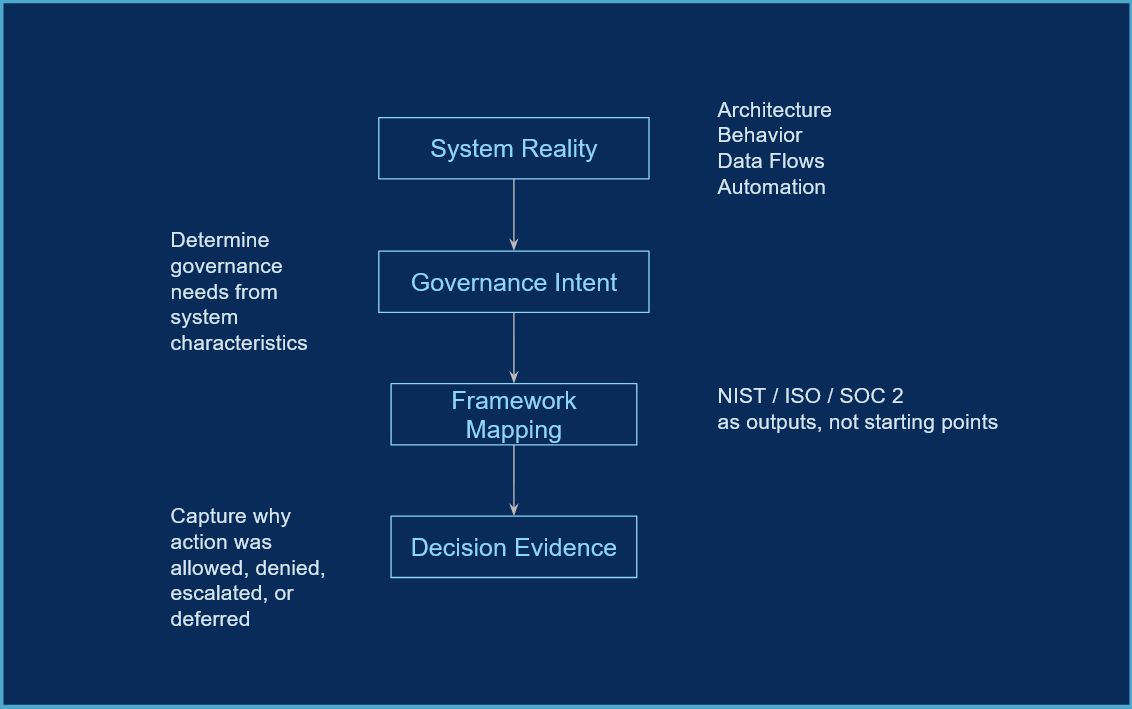
Intent-Driven Governance
Governance starts with how the system actually works, then determines which intents, controls, and decision evidence are required.
What it solves:
AI governance ambiguity Framework fatigue
Agent and tool risk Audit & regulatory uncertainty
Non-human identity sprawl Governance drift
Advisory Services
Short, scoped advisory services structured around the same principles: start with system reality, clarify the governance intent, and translate that into practical controls, evidence, and leadership-ready decisions.
Intent-based AI governance design
Clear limits on what AI systems can access and do
Regulator-ready governance models
AI Governance Architecture
AI risk in loss-exposure terms
ERM-aligned reporting
Board-level narratives
Risk Translation & Executive Reporting
Control Intent & Governance Automation
Pre-audit / pre-regulatory readiness
Product launch & M&A review
Partner advisory support
Readiness & Advisory
Common engagement examples:
• Evaluate an AI-enabled workflow for admissibility, authority, context, actions, and evidence
• Translate AI governance requirements into system-level control expectations
• Review whether a proposed AI use case needs run, check, or gate treatment
• Help a security or GRC team prepare for executive discussion of AI risk
• Map system facts to applicable NIST, ISO, SOC 2, or internal control expectations
• Support a consulting or vCISO team on complex AI governance questions
Ready to Talk?
Tell me where governance, risk, or system control is challenging and I’ll help you find a practical path forward.