AI Admissibility™
Governing What AI Systems Are Allowed to Do
AI-enabled systems increasingly do more than generate content. They can call tools, change records, trigger workflows, invoke APIs, and act across enterprise environments.
That creates a different governance problem.
The central question is no longer only: Did the model produce a good answer?
It is: Should this proposed action be allowed to proceed?
AI Admissibility is a control model for answering that question before a consequential action occurs.

The Model Is Not the Control Point
AI security often focuses on model behavior: prompting, guardrails, testing, red-teaming, monitoring, and model safety.
Those measures are useful, but they do not by themselves decide what an AI-enabled system is permitted to do.
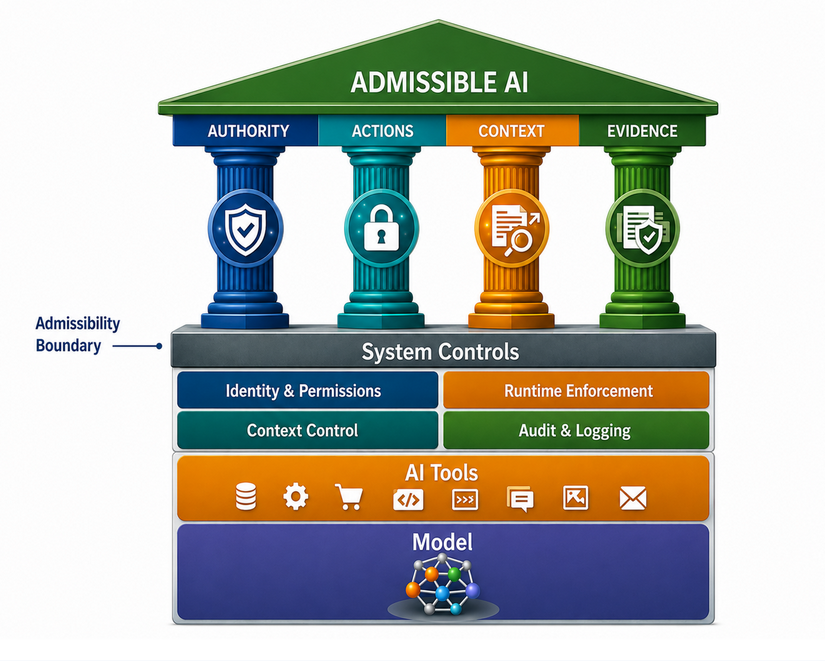
AI Admissibility moves the control point into the surrounding system.
The model may reason or propose an action. The surrounding system determines whether that action is allowed.
Four Conditions for Admissibility
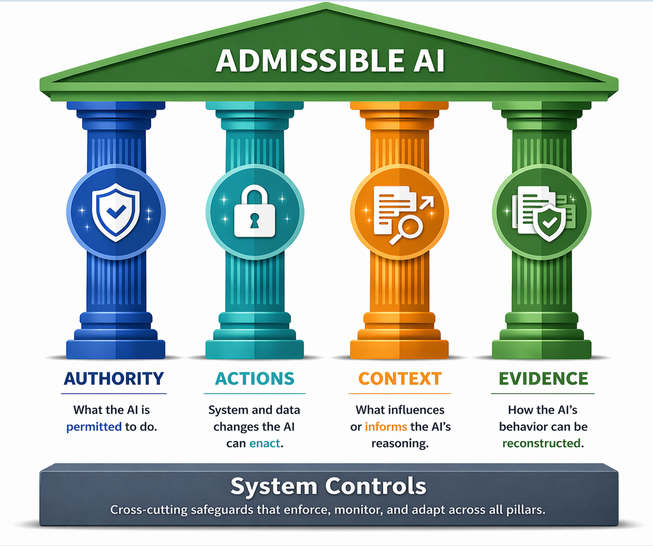
Before a consequential action proceeds, the system evaluates four conditions.
Authority
Who or what is allowed to act?
Under which identity, on whose behalf, with what delegated authority, and for how long?
Actions
What is the system designed and permitted to do?
Which operations, resources, parameters, and destinations are within scope?
Context
What information is present, and what is permitted to influence model behavior or the admissibility decision?
Is that information trustworthy, relevant, current, and allowed to play the role the system is giving it?
Evidence
What must be established before execution?
And what must remain provable afterward about what was proposed, evaluated, decided, enforced, and executed?
The Admissibility Boundary
The four conditions become meaningful only when they are evaluated at a point where the outcome can be enforced.
That point is the Admissibility Boundary.
At the Boundary, the surrounding system evaluates whether a proposed consequential action satisfies the required conditions and produces a controlled outcome:
Allow · Deny · Defer · Escalate
The Boundary is a function, not a product.
Depending on the system, it may be implemented through authorization services, policy engines, API gateways, workflow interlocks, transaction controls, execution brokers, orchestration controls, or other mechanisms.
The important question is not which product is used.
It is whether the consequential action can occur without passing through the required decision and enforcement point.
From Governance Intent to Enforceable Control
AI Admissibility begins with Control Intent: what must be true before a consequential action is allowed.
The method then translates that intent into conditions the system can evaluate and enforce.
This creates a direct path from governance language to operating behavior:
Control Intent → Authority, Actions, Context, Evidence → Admissibility Boundary → Enforced Outcome
The goal is not to make the model deterministic.
The goal is to make consequential behavior governable even when the model is imperfect.

Applying AI Admissibility
AI Admissibility can be used to examine existing or proposed AI-enabled systems and ask:
Where can AI output become business consequence?
What authority is being exercised?
What actions are actually within scope?
What information is allowed to influence the decision?
What evidence must exist before and after execution?
Where must the decision be enforced?
Can the system bypass that control point?
Can individually acceptable actions combine into an impermissible outcome?
The result is a clearer understanding of what must be controlled, where enforcement is required, and what must be provable.
Workshop and Advisory Applications
AI Admissibility can support:
AI Admissibility Control Design Workshops
Structured working sessions that apply Authority, Actions, Context, Evidence, and Boundary analysis to a real AI-enabled workflow or system.
AI Governance and Control Assurance
Evaluation of whether AI-related governance requirements are actually reflected in enforceable system behavior.
Control and Evidence Design
Definition of the decision conditions, enforcement requirements, and evidence needed to govern consequential AI-enabled actions.
The objective is not to replace the organization’s architects and engineers.
It is to define what must be true, where control must exist, and what must be provable so technical teams can implement appropriate mechanisms.
AI Governance Has to Operate in the System
Policies, frameworks, testing, and guardrails all have value.
But governance becomes real only when the system can determine whether a consequential action is allowed before execution — and enforce the answer.
That is AI Admissibility.